
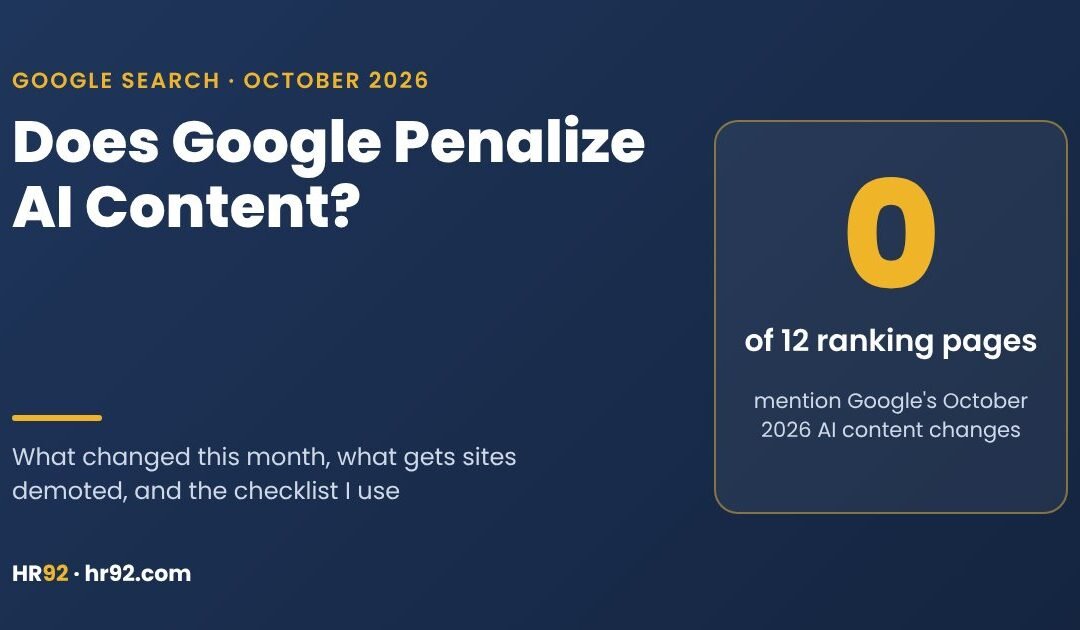

Does Google penalize AI content? No. Google has said since February 2023 that using AI is not against its guidelines, and it still says so. What Google penalizes is low-value content made at scale to rank, however it was produced, and in October 2026 it raised the bar: it now calls it “critical” to fact-check every piece of AI content by hand before you publish.
So the question isn’t whether you used ChatGPT or Gemini. It’s whether a person checked the facts, added something new and put their real name on it.
Below: what Google changed this month, what actually gets sites demoted, what our check of 12 ranking pages found, and the checklist I use before anything AI-assisted goes live on hr92.com.
- Google doesn’t penalize content for being AI-written. Its scaled content abuse policy targets mass-produced, low-value pages “no matter how it’s created”.
- October 2026 brought three changes: manual fact-checking is now “critical” (titles, meta descriptions, structured data and alt text included), main content is judged on effort, originality, skill and accuracy, and fake author profiles count as deception.
- None of the 12 pages we checked that rank for this question mention any of the October 2026 changes.
Does Google penalize AI content?
Not for being AI content. Google’s own wording, from its February 2023 guidance on AI-generated content: “Appropriate use of AI or automation is not against our guidelines.” Its ranking systems aim to reward original, high-quality content “however it is produced”.
The penalty people fear is real, though. It just isn’t about the tool. Here’s how I’d sum up where the line sits today.
| What you do with AI | Where Google stands | Risk |
|---|---|---|
| Research, outlines, first drafts that a person then checks, rewrites and adds to | Fine. Google says AI can be “particularly useful” for research and structure | Low |
| Publishing AI drafts with no fact-check | Against Google’s October 2026 guidance, which calls manual fact-checking “critical” | Medium: errors are a quality signal |
| Hundreds of near-identical pages (city pages, keyword variations) with nothing original | Scaled content abuse, a spam policy violation | High: demotion or manual action |
| Invented “expert” authors with AI headshots or fake credentials | Deception, and “a signal of a low-quality page” | High |
| A page for every fan-out query variation, built to get into AI answers | Scaled content abuse, per Google’s AI features guide | High |
What changed in Google’s AI content guidance in October 2026?
Three of Google’s documents changed in the first week of October 2026. Together they’re the most specific Google has ever been about how AI-assisted content should be made.
1. Manual fact-checking is now “critical” (October 1)
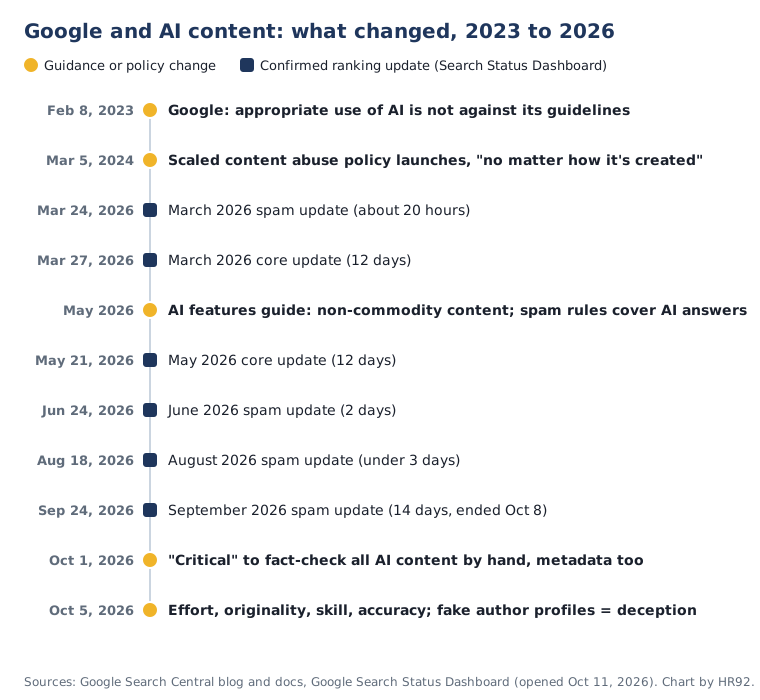
Google rewrote its guidance on using generative AI content (last updated October 1, 2026, per the page). The key line: “It is critical to manually factcheck and review all AI-generated content for accuracy and trustworthiness before publishing.”
The reason Google gives is plain. Generative models “don’t retrieve facts, but predict a likely sequence of words”, so their output can contain hallucinations. Google’s documentation changelog says the update brings the page in line with what it presents at developer events.
2. Main content is judged on effort, originality, skill and accuracy (early October)
Google’s helpful content guide (last updated October 5, 2026) gained a section on main content. It says that beyond E-E-A-T, “one of the most critical factors for assessing page quality is the quality of the main content”. Quality raters are trained to look at four attributes:
| Attribute | Google’s description, shortened | What it means for AI drafts |
|---|---|---|
| Effort | How much human work went into the content. Generating large amounts of text “without manual oversight or curation” is little to no effort | Editing, testing and adding your own material is the effort |
| Originality | Information or perspectives not already available elsewhere | A rewrite of the top 5 results scores zero here |
| Talent or skill | Clear writing, well-made media, tools that work | Generic AI prose is easy to spot and dull to read |
| Accuracy | Factually correct; for health, money and safety topics, consistent with expert consensus | Hallucinated stats and dead links fail this one |
One sentence in that section deserves a highlight: “Attribution or giving credit to other sources doesn’t replace the need for original effort.” Citing ten studies doesn’t make a summary original.
3. Fake authors are now named as deception (early October)
The same guide now warns against “deceptive authorship information”. Its examples: AI-generated headshots, made-up names and false credentials used to make content look like it was written by human experts. Google says any form of deception makes a page untrustworthy to users and to its automated quality systems. I covered how to do author pages properly in my guide to E-E-A-T author bios.
What else happened the same fortnight
- The September 2026 spam update started on September 24 and ran for 13 days and 16 hours, per the Search Status Dashboard. My breakdown is in how to tell if the spam update hit you.
- Practitioners reported more manual actions for thin and scaled content, including Marie Haynes, who told Search Engine Roundtable she went from almost no requests to several a week. Google hasn’t confirmed a rise.
- At Search Central Live in Barcelona, Google’s Duy Nguyen said the team is now using AI to help catch more spam, according to John Campbell’s day 3 recap.
How has Google’s stance on AI content changed since 2023?
The core position hasn’t moved: judge the content, not the tool. What has changed is how precisely Google describes “bad” content, and how often it runs spam updates. 2026 has had four confirmed spam updates and two core updates so far, plus a Discover core update in February.
What does Google penalize? Scaled content abuse
Scaled content abuse is Google’s name for making many pages “for the primary purpose of manipulating search rankings and not helping users”. It’s in Google’s spam policies, and it’s the policy behind almost every “AI content penalty” story you’ll read.
When Google introduced it in March 2024, it said it would act “no matter whether content is produced through automation, human efforts, or some combination”. A content farm of underpaid writers breaks the same rule as a script calling an AI model.
Google’s examples include:
- Using generative AI tools to generate many pages without adding value for users
- Scraping feeds or search results, including through synonymizing, translating or other obfuscation
- Stitching content from different pages together without adding value
- Creating multiple sites to hide the scaled nature of the content
Two things can happen if you cross the line. Google’s automated systems can demote the pages, often around a spam update. Or a reviewer can apply a manual action, which shows up in Search Console under Security & Manual Actions. The second one comes with a message; the first doesn’t.
Can Google detect AI content?
Google has never said it ranks pages lower because a detector flagged them as AI-written, and its stated policy makes that unnecessary. It judges the content. Here’s what’s on the record:
- Google says it now uses AI to help catch spam (Search Central Live Barcelona, October 2026, as reported). That’s AI finding spam patterns, not a penalty for AI text as such.
- On October 7, 2026, Google opened its SynthID Detector to everyone. It checks whether an image, video or audio file was made with AI from Google or partners including OpenAI and NVIDIA. The announcement doesn’t mention text or ranking.
- For ecommerce, Google Merchant Center already requires AI-generated images to carry IPTC metadata and AI-generated product titles and descriptions to be labeled, per the same guidance page.
My take: stop asking whether Google can tell. Ask whether a reader could tell the page adds nothing. That’s the test Google’s raters are trained on, and it’s the one that costs rankings.
What does the ranking data show about AI content?
The best public study I’ve seen is Ahrefs’ July 2026 analysis of 1,000,000 pages from 100,000 search results, scored with its own AI detector:
| Finding (Ahrefs, June 2026 data) | Number |
|---|---|
| Positions 1 to 3 that are 100% AI-generated | 5.3% |
| Top-3 rankings held by pages under 50% AI content | 82.2% |
| Indexation rate, low-AI pages vs very-high-AI pages | 49.28% vs 40.35% |
| Organic impressions, low/moderate AI vs high/very-high AI | 2 to 3 times higher |
So fully AI-written pages can rank at the top, but heavily AI-written pages do worse on average. Two cautions: AI detectors make mistakes, and correlation isn’t cause. A site that publishes unedited AI text usually has other quality problems too.
Do the pages ranking for this question follow Google’s rules? Our check
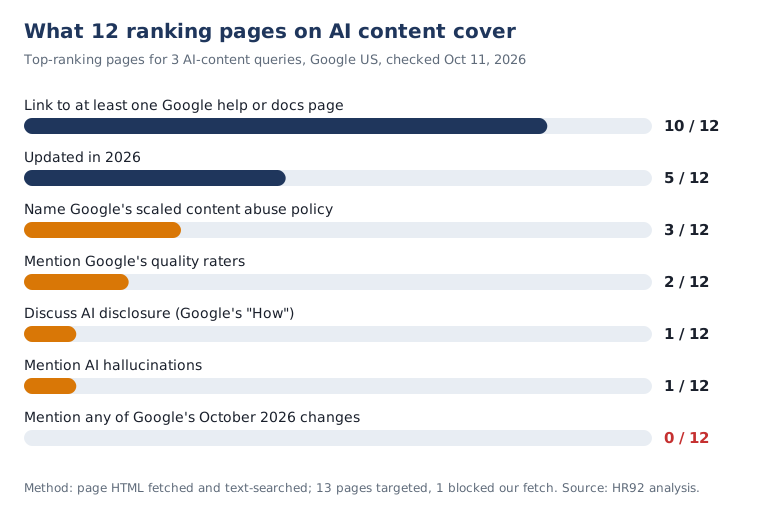
I wanted to know whether the pages Google ranks for “does Google penalize AI content” reflect Google’s current guidance. On October 11, 2026, we took the top non-forum results for that query and two related ones (“is AI content bad for SEO” and “can Google detect AI content”) on Google US: 13 pages.
One blocked our fetch, leaving 12. We searched each page’s text for the points Google’s documents now stress.
What stood out:
- 0 of 12 mention any of the October 2026 changes. That’s expected for pages written before October, but it means every one of them now misses Google’s most specific advice to date.
- 3 of 12 name the scaled content abuse policy, the actual rule behind AI-related demotions.
- 1 of 12 mentions hallucinations, the reason Google gives for requiring a manual fact-check.
- 7 of 12 show no 2026 date at all. The oldest was first published in 2023.
We also ran the top 5 through the HR92 SEO audit. Technically they’re solid: overall scores from 77.1 to 86.6 out of 100 (median 81.3), and all five scored 100 on structured data. The gap isn’t technical. It’s currency and accuracy, which is exactly what Google’s October update is about.
How to use AI for content without risking a penalty
This is the checklist I run before anything AI-assisted goes live. Each line maps to something Google has written down, not to SEO folklore.
- Fact-check every claim by hand against the primary source, opened today. Cut anything you can’t verify.
- Check the metadata too: title tag, meta description, structured data and image alt text.
- Add something the top results don’t have: your own data, a test, screenshots, a worked example, a template.
- Put a real person’s name on it, linked to a real author page. No invented personas, no AI headshots.
- Disclose how AI was used when a reader would reasonably wonder.
- Edit for a human reader: short paragraphs, plain words, opinions with reasons.
- Publish what you’d stand behind, at a pace you can review. One page per real need, not one per keyword variation.
- Don’t fake freshness. Change the “updated” date only when the content changed substantially.
- Keep the headline honest. Google’s guide asks whether the title avoids “exaggerating or being shocking”.
- Re-check after every spam or core update in Search Console: Manual actions, then Performance by page.
If you’re producing at volume, the review step is where the cost goes. That’s fine. It’s also where the ranking value comes from, which is the whole point of Google’s “effort” attribute.
Should you disclose that you used AI?
Google doesn’t require a label on every AI-assisted page, but it recommends one where readers would expect it. Its “Who, How, and Why” section asks: if automation was used to substantially generate content, is that “self-evident to visitors through disclosures or in other ways”?
Two rules I’d follow:
- Disclose how AI was used, not only that it was. “Drafted with AI, fact-checked against the linked sources and edited by [name]” tells the reader something useful. “This post may contain AI” doesn’t.
- Don’t make AI the author. Google’s 2023 FAQ says giving AI an author byline “is probably not the best way” to make its role clear. The byline should belong to the person accountable for the content.
You’ll find our own disclosure at the bottom of this page.
Were you hit for AI content? How to tell
If traffic fell and you publish AI-assisted content, check these in order before blaming the AI:
| Check | Where | What it tells you |
|---|---|---|
| Manual action message | Search Console > Security & Manual Actions > Manual actions | A reviewer flagged the site. Fix it, then file a reconsideration request |
| Drop dates vs update dates | Search Console Performance vs the Search Status Dashboard | A drop that starts during a spam or core update points to that update |
| Which pages fell | Performance > Pages, compare periods | If the templated or thin pages fell most, that’s your answer |
| Indexing | Indexing > Pages | “Crawled, currently not indexed” growing usually means Google sees little value in those URLs |
Recovery from a demotion isn’t a form you fill in. You improve or remove the weak pages, and the gains usually show after Google reprocesses the site, often around a later update. My spam update recovery guide walks through it step by step.
Does AI content affect AI Overviews and AI Mode?
Same rules, same systems. Google’s guide to optimizing for generative AI features says AI Overviews and AI Mode are “rooted in our core Search ranking and quality systems”, and Google clarified in May 2026 that its spam policies apply to generative AI responses too.
The guide is unusually direct on two points that matter here:
- Non-commodity content wins. Google contrasts generic “7 Tips” style content with first-hand, expert takes, and warns against recycling what “could easily be produced by a generative AI model”.
- Don’t build a page for every fan-out query. Doing it to manipulate AI responses “violates Google’s scaled content abuse spam policy”.
It also says you don’t need llms.txt files, “chunked” content or special markup for Google’s AI features. You can see how your pages appear in them in Search Console’s generative AI report, which I covered in my guide to the AI performance report. If AI visibility is a priority, that’s what our generative engine optimization work focuses on.
FAQ
Does Google penalize AI-generated content in 2026?
No. Google penalizes low-value content produced at scale to manipulate rankings, whether a person or an AI wrote it. In October 2026 it added that AI content should be fact-checked by hand before publishing, and that fake author profiles are deception. Helpful, accurate AI-assisted content can rank.
Can Google tell if content is written by AI?
Google hasn’t said it uses AI-text detection as a ranking factor. It says it uses AI to help catch spam, and its SynthID Detector checks images, video and audio made with Google’s and partners’ AI tools. In practice, Google judges whether content is helpful and original, not which tool wrote it.
Is AI content bad for SEO?
Unedited AI content tends to perform worse. In Ahrefs’ 2026 study, pages with low or moderate AI content got 2 to 3 times the impressions of heavily AI-written pages. AI used for research and drafting, with human fact-checking and original additions, is fine.
How much AI content is too much?
Google doesn’t set a percentage. The line is value and scale: many pages with nothing original crosses into scaled content abuse. A single page fully drafted by AI can be fine if it’s accurate, reviewed and adds something readers can’t get elsewhere.
Do I need to label AI-generated content?
Not on every page. Google recommends disclosing how content was made where readers would reasonably expect it, and explaining how and why AI was used. Merchant Center does require labels on AI-generated product data and metadata on AI-generated images.
Can I recover from an AI content penalty?
Yes. For a manual action, fix or remove the flagged content and file a reconsideration request in Search Console. For an algorithmic demotion, improve or remove the weak pages and wait for Google to reprocess the site, which often takes until a later update.
More on the service side: SEO content writing and content marketing.