
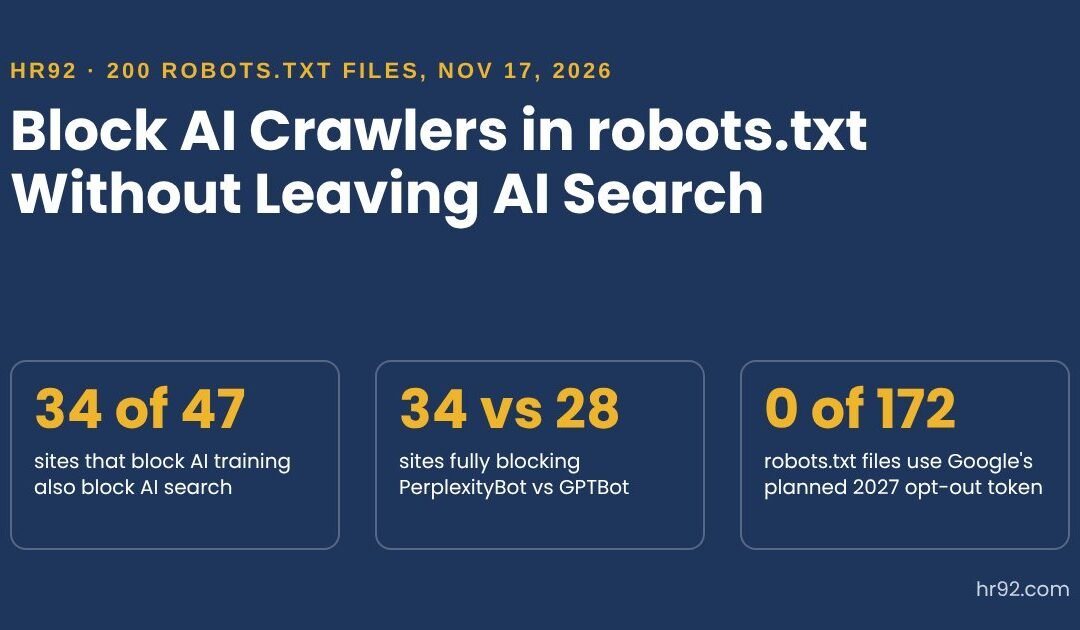

I checked how this plays out on real sites. On November 17, 2026 I fetched the robots.txt files of 200 websites (US small businesses, Qatar and UAE companies, publishers and large brands) and parsed them with HR92’s audit engine. Of the 47 sites that fully block at least one AI training crawler, 34 also block at least one AI search crawler. Some of that is deliberate. Some of it looks like a copied blocklist.
Below: the three policies you can pick, the exact user-agent tokens from each vendor’s own documentation, copy-paste recipes, Google’s planned shared opt-out for 2027, and how to test the result.
- Training and search are separate switches at OpenAI, Anthropic, Google, Apple, Meta and Amazon. Blocking GPTBot doesn’t remove you from ChatGPT search; blocking OAI-SearchBot does.
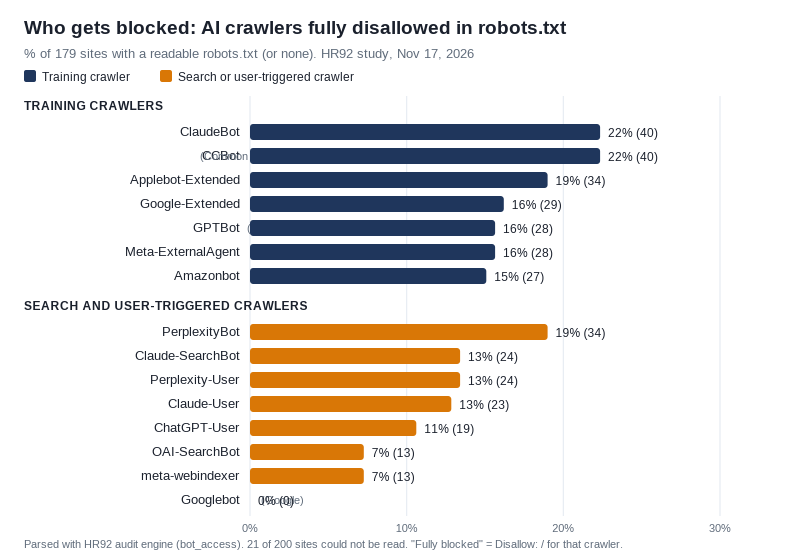
- In our 200-site study, 34 of the 47 sites that block AI training also block OAI-SearchBot, Claude-SearchBot or PerplexityBot. PerplexityBot (a search crawler) was fully blocked more often than GPTBot: 34 sites vs 28.
- Google-Extended doesn’t keep you out of AI Overviews or AI Mode. That’s a separate Search Console setting, and it removes your links too.
- Google (Oct 30, 2026) plans to read a shared IETF training opt-out token,
__usage_ai-training, in 2027. Anthropic says it began recognizing it on Oct 30 and is rolling it out. None of the 172 robots.txt files we read uses it yet. - robots.txt is a public request. Bots that ignore it need a firewall or CDN rule.
Which AI crawlers to block: the decision table
The right robots.txt depends on one decision: do you object to model training, to AI answers, or to both? Pick the row that matches, then copy the full recipe from the recipes section.
| Your policy | Block these tokens | Keep allowed | robots.txt core | Trade-off |
|---|---|---|---|---|
| 1. Allow all AI (most local businesses) | None | Everything | User-agent: * |
Your content may be used for training; maximum chance of AI citations |
| 2. Block training only (stay in AI answers) | GPTBot, ClaudeBot, Google-Extended, Applebot-Extended, CCBot, meta-externalagent, Amazonbot, plus __usage_ai-training |
OAI-SearchBot, ChatGPT-User, Claude-SearchBot, Claude-User, PerplexityBot, Perplexity-User, meta-webindexer, Googlebot, Applebot, Bingbot | User-agent: GPTBot |
Blocking Google-Extended also ends grounding in Gemini Apps, so you lose eligibility for cited links there |
| 3. Block all AI (keep classic search) | Everything in row 2, plus OAI-SearchBot, ChatGPT-User, Claude-SearchBot, Claude-User, PerplexityBot, Perplexity-User, meta-webindexer, meta-externalfetcher, Amzn-SearchBot, Amzn-User | Googlebot, Bingbot, Applebot | User-agent: OAI-SearchBot |
You disappear from ChatGPT search, Claude and Perplexity answers. AI Overviews need the separate Search Console control |
Tokens checked against each vendor’s crawler documentation on November 17, 2026 (links in the next section). Amazonbot and meta-externalagent are mixed-purpose crawlers; see the notes below the vendor table.
Training bots vs search bots vs user-triggered fetchers
AI crawlers fall into three groups with different consequences. Training crawlers collect pages that may be used to train future models. Search crawlers build an index that AI answers cite and link to. User-triggered fetchers load one page because a person asked an assistant about it.
The vendors draw that line themselves. OpenAI’s crawler page says “Each setting is independent of the others” and gives the example of allowing OAI-SearchBot to appear in search results while disallowing GPTBot. Anthropic’s help page lists three robots and says disabling Claude-SearchBot “may reduce your site’s visibility and accuracy in user search results.” Perplexity says PerplexityBot “is not used to crawl content for AI foundation models.”
| Company | Training token | Search or index token | User-triggered fetcher | Source |
|---|---|---|---|---|
| OpenAI | GPTBot | OAI-SearchBot | ChatGPT-User (“robots.txt rules may not apply”) | OpenAI crawlers |
| Anthropic | ClaudeBot | Claude-SearchBot | Claude-User | Claude Help Center |
| Perplexity | None listed | PerplexityBot | Perplexity-User (“generally ignores robots.txt rules”) | Perplexity crawlers |
| Google-Extended (a control token, not a crawler) | Googlebot | Not covered here | Google common crawlers | |
| Apple | Applebot-Extended (a control token, “does not crawl webpages”) | Applebot | Not listed | About Applebot |
| Meta | meta-externalagent | meta-webindexer | meta-externalfetcher (“may bypass robots.txt rules”) | Meta web crawlers |
| Amazon | Amazonbot (“may be used to train Amazon AI models”) | Amzn-SearchBot | Amzn-User | Amazon bots |
| Common Crawl | CCBot (an open dataset many AI labs use) | None | None | CCBot |
Four details that most bot lists miss:
- Google-Extended is not an AI Overviews switch. Google says Google-Extended controls training of future Gemini models and grounding in Gemini Apps and Vertex AI, and “does not impact a site’s inclusion in Google Search nor is it used as a ranking signal.”
- Apple’s main crawler can feed training too. Apple says Applebot data “may also be used to help train Apple foundation models,” and you opt out by disallowing Applebot-Extended. For Apple’s AI answers with links, Apple points to the nosnippet meta tag.
- Anthropic’s old tokens are gone. Anthropic’s page now lists only ClaudeBot, Claude-User and Claude-SearchBot. In our study 42 sites still name anthropic-ai or Claude-Web, the older strings. All but one also name ClaudeBot, so it’s harmless clutter, but it tells you the list was copied, not checked.
- Two tokens are mixed-purpose. Amazonbot is described as improving Amazon’s products as well as training, and Meta describes meta-externalagent as crawling for uses “such as training foundation AI models.” Amazon’s separate Amzn-SearchBot covers search experiences such as Alexa.
What 200 real robots.txt files show
Most websites don’t block AI crawlers at all, and the ones that do often block AI search along with training. That’s the short version of our study. I fetched robots.txt from 70 US small and medium business sites, 40 Qatar and UAE business sites, 50 publishers and 40 large brands, then ran each file through the same parser the HR92 free SEO audit uses.
| Segment | Readable | Block 1+ training crawler | Of those, also block AI search | Content-Signal line | No robots.txt |
|---|---|---|---|---|---|
| US small businesses | 68 of 70 | 3 (4%) | 1 of 3 | 1 | 1 |
| Qatar and UAE businesses | 35 of 40 | 3 (9%) | 2 of 3 | 0 | 2 |
| Publishers | 45 of 50 | 38 (84%) | 29 of 38 | 1 | 0 |
| Large brands | 31 of 40 | 3 (10%) | 2 of 3 | 0 | 0 |
| All | 179 of 200 | 47 (26%) | 34 of 47 (72%) | 2 | 3 |
HR92 study, November 17, 2026. “Block” = the file disallows the whole site (Disallow: /) for that token. “AI search” = OAI-SearchBot, Claude-SearchBot or PerplexityBot. Four more sites served an HTML page at /robots.txt, which crawlers treat as having no rules. 21 sites couldn’t be read: 12 returned HTTP 403 to our script, 3 returned server errors and 6 failed at the network level.
What stands out:
- Publishers block, almost nobody else does. 84% of publishers block at least one training crawler, against 4% of US small businesses.
- Training and search get blocked together. Of 28 sites that block GPTBot, 13 also block OAI-SearchBot. Of 40 that block ClaudeBot, 24 also block Claude-SearchBot.
- PerplexityBot is blocked more than GPTBot. 34 sites fully block PerplexityBot, 12 of them without blocking GPTBot. Perplexity documents it as a search crawler, not a training one.
- Googlebot is never blocked. 29 sites block Google-Extended, and none of them blocks Googlebot, which is how the control is meant to work.
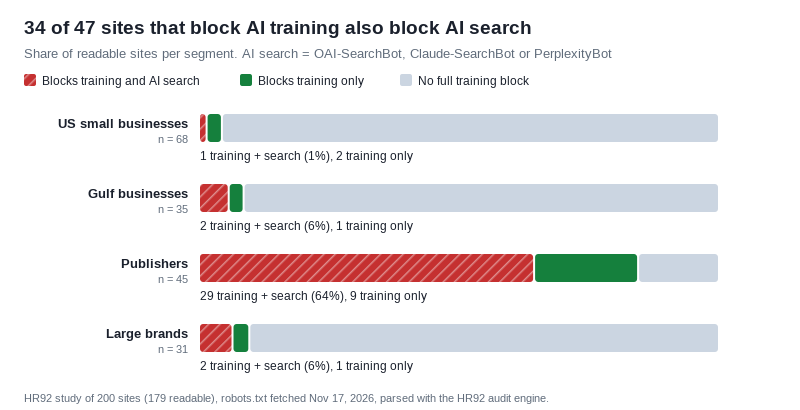
Among publishers, much of this is policy, not error. The robots.txt files of The New York Times, NBC News and USA Today disallow OAI-SearchBot, Claude-SearchBot and PerplexityBot along with the training crawlers, a choice those publishers make in public.
Outside publishing the numbers are small: 9 non-publisher sites block training, and 5 of them also block an AI search crawler. Reading those five files, most look deliberate.
One allows only Googlebot and Bingbot, and two name OAI-SearchBot and Claude-SearchBot without blocking them while blocking PerplexityBot. One small business file blocks ChatGPT-User and PerplexityBot next to GPTBot and never mentions OAI-SearchBot, which is what a pasted blocklist looks like.
Limits: one day, one fetch per site, from a data center. Some sites answer bots differently by IP, and 12 returned HTTP 403 to our script. “Blocked” means the robots.txt request, not what a firewall does.
Copy-paste robots.txt recipes for 3 policies
A robots.txt recipe is a complete set of groups you paste into the file at the root of your domain (example.com/robots.txt). Each subdomain needs its own file. Under RFC 9309, several User-agent lines can share one group, and a crawler that finds its own name follows that group instead of the * group.
Recipe 1: allow all AI crawlers
User-agent: *
Disallow: /wp-admin/
Allow: /wp-admin/admin-ajax.php

Sitemap: https://example.com/sitemap.xml
That’s the WordPress default plus a sitemap line. Nothing names an AI crawler, so every one of them is allowed.
Recipe 2: block AI training, stay in AI search
# AI training: opt out
User-agent: GPTBot
User-agent: ClaudeBot
User-agent: Google-Extended
User-agent: Applebot-Extended
User-agent: CCBot
User-agent: meta-externalagent
User-agent: Amazonbot
Disallow: /

# Shared IETF training signal (Google plans support in 2027)
User-agent: __usage_ai-training
Disallow: /

# Everyone else, including OAI-SearchBot, Claude-SearchBot, PerplexityBot
User-agent: *
Content-Signal: search=yes, ai-input=yes, ai-train=no
Disallow: /wp-admin/
Allow: /wp-admin/admin-ajax.php

Sitemap: https://example.com/sitemap.xmlRecipe 3: block all AI crawlers, keep Google and Bing search
# Training, AI search and user-triggered AI fetchers
User-agent: GPTBot
User-agent: OAI-SearchBot
User-agent: ChatGPT-User
User-agent: ClaudeBot
User-agent: Claude-SearchBot
User-agent: Claude-User
User-agent: PerplexityBot
User-agent: Perplexity-User
User-agent: Google-Extended
User-agent: Applebot-Extended
User-agent: CCBot
User-agent: meta-externalagent
User-agent: meta-webindexer
User-agent: meta-externalfetcher
User-agent: Amazonbot
User-agent: Amzn-SearchBot
User-agent: Amzn-User
User-agent: __usage_ai-training
Disallow: /

User-agent: *
Content-Signal: search=yes, ai-input=no, ai-train=no
Disallow: /wp-admin/
Allow: /wp-admin/admin-ajax.php
Recipe 3 still leaves Google’s AI features on. To leave AI Overviews and AI Mode, Google’s Search generative AI control in Search Console is the switch. Excluding your site means links to it and its content “won’t appear” in those features, and “You won’t receive any traffic or impressions from these features.” The control “doesn’t affect AI training”; that’s Google-Extended’s job.
How to edit robots.txt in WordPress
WordPress builds a virtual robots.txt (User-agent: *, Disallow: /wp-admin/, Allow: /wp-admin/admin-ajax.php) and lets plugins change it through the robots_txt filter. If your host has a physical robots.txt file in the web root, edit that file instead.
Otherwise the easiest route is your SEO plugin. In All in One SEO it’s Tools > Robots.txt Editor > Enable Custom Robots.txt, per AIOSEO’s documentation, which adds your rules to WordPress’s default ones. If you build on WordPress with us, our WordPress team sets this during launch.
Content-Signal and the IETF AIPREF token: emerging, not settled
Content-Signal is a robots.txt line, published by Cloudflare on September 24, 2025, that states three preferences: search, ai-input and ai-train, each yes or no. Cloudflare defines ai-input as feeding content into AI models for things like “grounding” and “generative AI search answers,” and says search “does not include providing AI-generated search summaries.” It also says plainly that “content signals express preferences; they are not technical countermeasures.”
Two of the 179 sites in our study had a Content-Signal line: The Atlantic (search=yes, ai-input=no, ai-train=no) and one Atlanta CPA firm that says yes to all three. Google’s announcement doesn’t mention Content-Signal; I found no AI company in this article’s sources that documents honoring it.
The IETF route is the one Google has committed to. On October 30, 2026, Google announced plans to support a shared AI training control in robots.txt based on the IETF AIPREF working group’s work. When a site uses this policy token to opt out of training “and Google-Extended is not explicitly specified,” Google “plans to interpret that as if the publisher had disallowed Google-Extended.”
The post says Google aims to support it “along with other AI providers in 2027.” Google’s crawler page, updated the same day, says “early 2027.”
| Signal | Syntax | Who has said they read it | Status on Nov 17, 2026 |
|---|---|---|---|
| Vendor tokens (GPTBot, ClaudeBot, Google-Extended…) | User-agent group + Disallow | Each vendor for its own token | Live; the only thing that works everywhere |
| AIPREF policy token | User-agent: __usage_ai-training + Disallow / Allow |
Anthropic (since Oct 30, 2026); Google (planned 2027) | Individual Internet-Draft, revision 01 (Nov 16, 2026); not adopted by the working group |
| Content-Signal | Content-Signal: search=yes, ai-input=yes, ai-train=no |
Cloudflare publishes it; no vendor commitment found in this article’s sources | Emerging; 2 of 179 sites use it |
The draft itself, by Kevin Kelley, says the token “introduces no new directive names and no new grammar,” that the * group must not count as matching it, and that it “is not a directive for crawling behavior.”
The datatracker lists it as an individual draft with “no formal standing in the IETF standards process.” The AIPREF working group’s own documents, the vocabulary and the HTTP attachment drafts, are still Internet-Drafts too.
Anthropic’s help page says it treats rules that name ClaudeBot “as more specific than the general signal.” Google says the same about Google-Extended: company tokens “will continue to function alongside this new joint signal.” So naming the vendor tokens is still the reliable layer, and the shared token is a cheap extra line.
What robots.txt can’t do
robots.txt is a voluntary standard, and it controls crawling, not use of content already collected. RFC 9309, the Robots Exclusion Protocol, says “These rules are not a form of access authorization.”
- It doesn’t stop bots that ignore it. The well-known vendors document compliance for their crawlers, but scrapers that spoof a browser won’t read your file.
- User-triggered fetchers play by different rules. OpenAI, Perplexity, Meta and Amazon each say their user-triggered agent may not follow robots.txt.
- It isn’t retroactive. Anthropic says restricting ClaudeBot signals that “future materials” should be excluded from training. Content collected earlier isn’t recalled.
- It doesn’t control Google’s AI features. That’s the Search Console control, or nosnippet and noindex at page level, as listed in Google’s Control what you share with Google Search page, refreshed on October 21, 2026.
If you need enforcement, use your CDN or firewall. Cloudflare’s AI Crawler and Agent access policies (updated November 2, 2026) let you set separate actions for Search, Agent and Training traffic.
Two cautions from the vendors: Perplexity asks you to allow its published IP ranges in your firewall if you want to appear in its answers, and Anthropic warns that blocking its IPs “may not work correctly” as an opt-out because it stops ClaudeBot from reading your robots.txt.
How to test your AI crawler rules
Testing a robots.txt change takes about five minutes and catches most mistakes. This is the order I use.
- Open the live file. Visit example.com/robots.txt on every host you use (www and non-www, shop subdomains). Check that it’s plain text, not an HTML page: 4 sites in our study served HTML there.
- Run a quick parser check. Python’s built-in robots parser gives you a fast yes or no per token (it’s simpler than Google’s parser, so treat it as a smoke test).
- Check Google’s view. Search Console’s robots.txt report shows the files Google found for the top 20 hosts, when they were crawled and any errors. It’s available for domain-level properties.
- Watch your logs. Look for the tokens in your server or CDN logs and verify the IPs against each vendor’s published list (OpenAI, Anthropic, Perplexity, Amazon and Common Crawl publish their IP ranges). OpenAI says search changes can take about 24 hours to apply.
- Re-audit. The HR92 audit reports AI search crawlers and training crawlers as separate checks, so a blocked search bot shows up as a fail.
python3 -c "import urllib.robotparser as r; p=r.RobotFileParser('https://example.com/robots.txt'); p.read(); [print(b, p.can_fetch(b, 'https://example.com/')) for b in ['GPTBot','ClaudeBot','Google-Extended','OAI-SearchBot','Claude-SearchBot','PerplexityBot','Googlebot']]"For recipe 2 you want False for the first three and True for the rest. Then check whether AI answers still cite you; I describe a repeatable way to do that in our AI visibility tracking test, and Google’s side shows up in the Search Console AI performance report.
AI crawler robots.txt checklist
- Decided: allow all, block training only, or block all AI
- Every token in the file matched to its vendor’s current documentation
- OAI-SearchBot, Claude-SearchBot and PerplexityBot allowed, unless you mean to leave AI search
- Old tokens (anthropic-ai, Claude-Web) removed or at least paired with ClaudeBot
__usage_ai-traininggroup added if you opt out of training- Search Console Search generative AI control set the way you intend
- Same file on every host and subdomain
- File served as plain text with status 200
- Parser check and log check done
- CDN or firewall rule added if you need enforcement
FAQ
Does blocking GPTBot remove my site from ChatGPT?
No. OpenAI uses OAI-SearchBot for ChatGPT search and says each setting is independent. Sites that opt out of OAI-SearchBot “will not be shown in ChatGPT search answers,” though they can still appear as navigational links. Blocking GPTBot only says your content shouldn’t be used to train OpenAI’s foundation models.
Does blocking Google-Extended hurt my Google rankings?
No. Google’s crawler documentation says Google-Extended “does not impact a site’s inclusion in Google Search nor is it used as a ranking signal.” It does stop grounding in Gemini Apps, and Google’s October 30 post says sites that allow Google-Extended “are eligible to appear in responses and receive clicks via grounding in Gemini Apps.”
How do I keep my site out of Google AI Overviews?
Use the Search generative AI control in Search Console (Settings > Search generative AI) and choose Exclude. Google says content is excluded within one to two days after the control goes live (some can take longer), and that you’ll get no traffic or impressions from those features. Your regular search listings stay.
Is PerplexityBot a training crawler?
No, by Perplexity’s own description. PerplexityBot “is designed to surface and link websites in search results on Perplexity” and isn’t used to crawl content for AI foundation models. Blocking it removes you from Perplexity’s answers. Some of the 19% block rate in our study is deliberate publisher policy; on a small business site it’s usually a copied list.
Will robots.txt remove my content from models that already trained on it?
No. robots.txt controls future crawling. Anthropic, for example, says restricting ClaudeBot signals that the site’s “future materials” should be excluded from training. Nothing in robots.txt recalls data collected earlier.
Should I add Content-Signal to my robots.txt?
It’s harmless and states your intent, but treat it as a preference with no confirmed reader in this article’s sources. If you opt out of training, the vendor tokens plus the __usage_ai-training group are the lines with published support.
The next step
Open your robots.txt today and read every User-agent line against the vendor table. If you see PerplexityBot, OAI-SearchBot or Claude-SearchBot under a Disallow and you want AI customers, that’s the line to fix first.
Related services: generative engine optimization (GEO) for brands that want more AI citations, and technical SEO for crawl rules, CDN settings and logs.